How to Calculate Your Take-Home Salary After FBR Tax Deductions in Pakistan (Current Fiscal Year Guidelines)
Your gross salary package looks impressive on an employment contract. Yet, the figure deposited into your bank account on the first of each month is invariably smaller. In Pakistan, the Federal Board of Revenue (FBR) mandates payroll tax deductions directly at the source under Section 149 of the Income Tax Ordinance, 2001.
Employers must calculate, withhold, and deposit your income tax before transferring your monthly compensation. Understanding how these progressive deductions work prevents budgeting surprises and helps you negotiate employment packages with total clarity.
Understanding the Legal Framework: Salaried vs. Non-Salaried Individuals
The FBR maintains two distinct taxation regimes for individuals: salaried and non-salaried (business or freelance professionals). You fall under the salaried class if your income from employment constitutes more than 75% of your total taxable income for the tax year (July 1 to June 30).
If your employment income falls below 75%—for instance, if you earn substantial income through private commercial contracting or rental properties—the FBR classifies you under the non-salaried individual slabs, which feature higher baseline tax rates.
Key Characteristics of Salaried Taxation:
- Pay-As-You-Earn (PAYE): Your company’s finance or HR department divides your estimated annual tax liability by 12 and deducts it each month.
- Progressive Slabs: Higher tax percentages apply only to the portion of income that exceeds each threshold, never to your total gross earnings.
- Annual Reconciliation: Your employer adjusts monthly withholdings at the end of the fiscal year based on bonuses, increments, or changes in statutory tax laws.
Current Progressive Income Tax Slabs in Pakistan
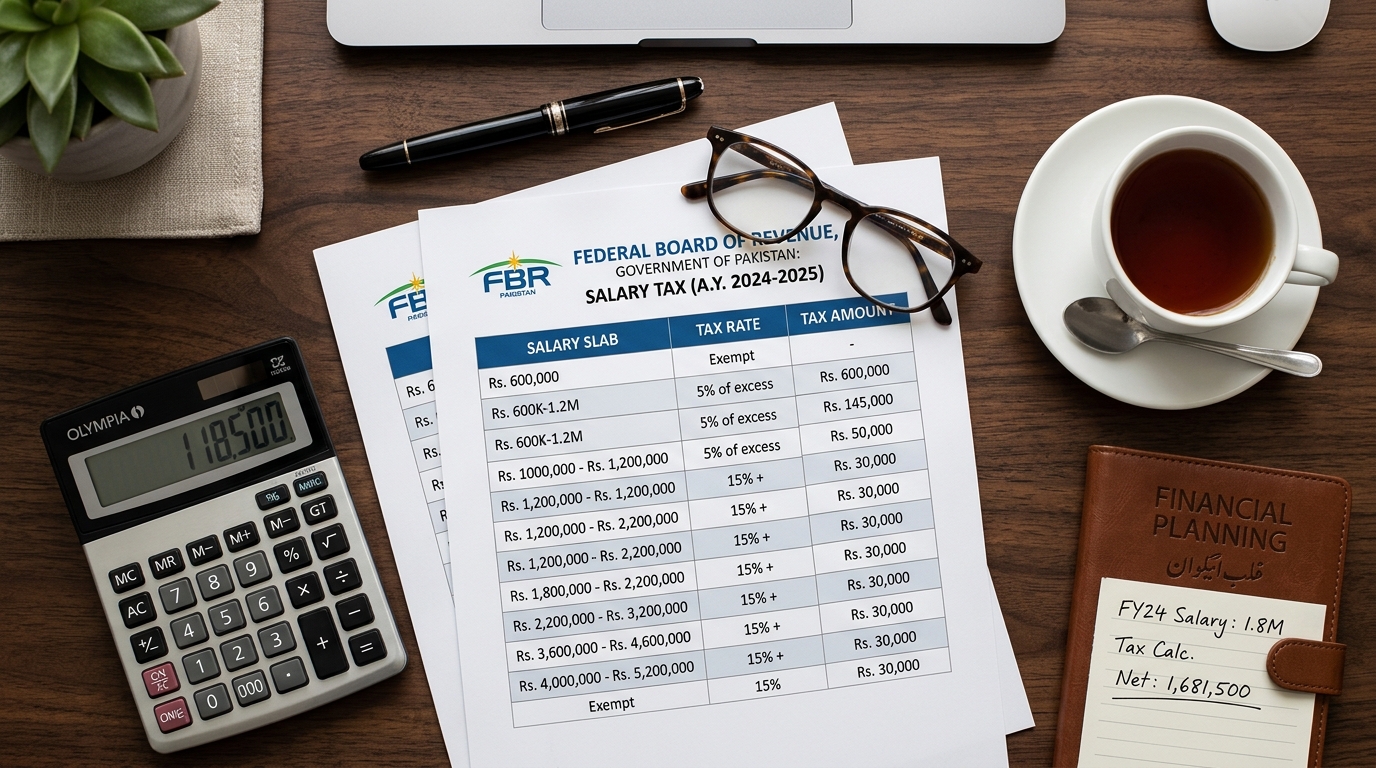
The National Assembly of Pakistan restructures income tax slabs through statutory Finance Acts to meet national revenue targets. Below is the official progressive tax schedule governing salaried individuals in Pakistan for the current fiscal year.
| Tax Slab | Annual Taxable Income (PKR) | Monthly Equivalent (PKR) | Fixed Base Tax (PKR) | Marginal Tax Rate on Excess |
|---|---|---|---|---|
| Slab 1 | Up to PKR 600,000 | Up to PKR 50,000 | PKR 0 | 0% (Completely Exempt) |
| Slab 2 | PKR 600,001 to PKR 1,200,000 | PKR 50,001 to PKR 100,000 | PKR 0 | 5% of amount exceeding PKR 600,000 |
| Slab 3 | PKR 1,200,001 to PKR 2,200,000 | PKR 100,001 to PKR 183,333 | PKR 30,000 | 15% of amount exceeding PKR 1,200,000 |
| Slab 4 | PKR 2,200,001 to PKR 3,200,000 | PKR 183,334 to PKR 266,667 | PKR 180,000 | 25% of amount exceeding PKR 2,200,000 |
| Slab 5 | PKR 3,200,001 to PKR 4,100,000 | PKR 266,668 to PKR 341,667 | PKR 430,000 | 30% of amount exceeding PKR 3,200,000 |
| Slab 6 | Exceeding PKR 4,100,000 | Exceeding PKR 341,667 | PKR 700,000 | 35% of amount exceeding PKR 4,100,000 |
*Note: High-income earners with an annual taxable income exceeding PKR 10 million face an additional 10% super-tax surcharge on their net tax liability.
Step-by-Step Formula: How to Calculate Net Income in Pakistan
Calculating your take-home salary after tax requires a structured four-step process. Never apply a marginal rate directly to your gross salary.
Step 1: Establish Your Total Gross Emoluments
Compile all elements of your compensation: Basic Salary, Cost of Living Allowances, Performance Bonuses, and Special Utility Allowances.
Step 2: Subtract Statutory Tax-Exempt Allowances
Not every rupee in your pay slip is taxable:
- Medical Allowance: Exempt up to 10% of your Basic Salary, provided your employer does not offer hospitalization or medical reimbursement. If your employer provides an insured health policy, the medical allowance becomes fully taxable.
- Recognized Provident Fund (RPF): Your employer’s contribution to an approved RPF is exempt up to one-tenth of your salary or PKR 150,000, whichever is lower.
Step 3: Determine Your Applicable Tax Slab
Locate your taxable annual income in the table above to identify your fixed base tax and the marginal percentage applicable to the excess balance.
Step 4: Compute Annual Tax and Monthly Net Pay
Apply the standard progressive tax formula:
Annual Tax = Fixed Base Amount + [(Taxable Income - Slab Floor) × Marginal Rate]
Monthly Withholding Tax = Annual Tax / 12
Monthly Take-Home Pay = Gross Monthly Salary - Monthly Withholding Tax - Non-Tax Deductions
Real-World Case Studies
To see the progressive tax engine in action, examine three realistic salary benchmarks in Pakistan:
Case Study 1: Junior Executive (PKR 80,000 / Month)
- Gross Annual Salary: PKR 80,000 × 12 = PKR 960,000
- Applicable Bracket: Slab 2 (PKR 600,001 to PKR 1,200,000)
- Base Tax: PKR 0
- Taxable Excess: PKR 960,000 - PKR 600,000 = PKR 360,000
- Annual Tax: PKR 360,000 × 5% = PKR 18,000
- Monthly Tax Deduction: PKR 18,000 / 12 = PKR 1,500
- Net Monthly Take-Home Pay: PKR 80,000 - PKR 1,500 = PKR 78,500 (Effective Rate: 1.88%)
Case Study 2: Mid-Level Professional (PKR 200,000 / Month)
- Gross Annual Salary: PKR 200,000 × 12 = PKR 2,400,000
- Applicable Bracket: Slab 4 (PKR 2,200,001 to PKR 3,200,000)
- Base Tax: PKR 180,000
- Taxable Excess: PKR 2,400,000 - PKR 2,200,000 = PKR 200,000
- Tax on Excess: PKR 200,000 × 25% = PKR 50,000
- Total Annual Tax: PKR 180,000 + PKR 50,000 = PKR 230,000
- Monthly Tax Deduction: PKR 230,000 / 12 = PKR 19,167
- Net Monthly Take-Home Pay: PKR 200,000 - PKR 19,167 = PKR 180,833 (Effective Rate: 9.58%)
Case Study 3: Senior Engineering Lead (PKR 350,000 / Month)
- Gross Annual Salary: PKR 350,000 × 12 = PKR 4,200,000
- Applicable Bracket: Slab 6 (Above PKR 4,100,000)
- Base Tax: PKR 700,000
- Taxable Excess: PKR 4,200,000 - PKR 4,100,000 = PKR 100,000
- Tax on Excess: PKR 100,000 × 35% = PKR 35,000
- Total Annual Tax: PKR 700,000 + PKR 35,000 = PKR 735,000
- Monthly Tax Deduction: PKR 735,000 / 12 = PKR 61,250
- Net Monthly Take-Home Pay: PKR 350,000 - PKR 61,250 = PKR 288,750 (Effective Rate: 17.50%)
Mandatory Payroll Deductions Beyond FBR Tax
Your net take-home salary is subject to statutory payroll withholdings outside of income tax:
- Employees' Old-Age Benefits Institution (EOBI): Mandatory federal social security contribution. Employees contribute 1% of the statutory minimum wage (currently PKR 370 per month). Employers contribute 5% on your behalf.
- Recognized Provident Fund (Employee Share): Most corporate organizations deduct 8.33% to 10% of your basic salary toward your retirement savings, matched rupee-for-rupee by the employer.
- Group Medical Insurance Co-Payments: If you opt to cover elderly parents or extended family members under corporate health coverage, companies deduct marginal insurance premiums directly from your pay slip.
The Value of Being an Active Filer on the FBR ATL
Withholding tax is deducted from your paycheck regardless of your filing status. However, remaining a Non-Filer on the FBR's Active Taxpayer List (ATL) causes severe economic penalties on daily consumer transactions:
- Cash Withdrawals: Non-filers pay a punitive 0.6% advance withholding tax on single-day banking withdrawals exceeding PKR 50,000. Filers pay 0%.
- Vehicle Purchases: Buying or registering a newly manufactured automobile carries double or triple the advance withholding tax for non-filers.
- Property Transactions: Purchasing real estate incurs a 3% advance tax for active filers versus up to 10.5% to 12% for non-filers.
- Bank Profit & Mutual Funds: Profit on debt and bank savings accounts is taxed at 15% for filers, compared to 30% for non-filers.
Legal Strategies to Reduce Your Income Tax
Under the Income Tax Ordinance, 2001, salaried individuals can claim legitimate tax credits to reduce their total liability:
- Voluntary Pension System (VPS) Contributions (Section 63): Investing in SECP-registered voluntary pension funds qualifies for a tax credit up to 20% of your taxable income for the year.
- Charitable Donations (Section 61): Direct monetary donations made via official banking cross-cheques to institutions listed in the Second Schedule of the Income Tax Ordinance yield a proportional rebate on your tax liability.
- Educational Expense Concessions: Parents earning an annual taxable income below PKR 1.5 million can claim statutory tax rebates against school fees paid for their children.
Summary & Instant Take-Home Calculation
Calculating your take-home pay requires knowing your basic allowances, mapping your earnings to the correct progressive FBR tier, and accounting for non-tax payroll withholdings. Never rely on rough estimates when making career moves or setting personal budgets.
Compute Your Net Salary in 10 Seconds
Take the guesswork out of Pakistani payroll taxes. Use our free, 100% private in-browser tax calculator to simulate your exact monthly take-home paycheck, effective tax rate, and deductible tiers.
Launch Free FBR Tax Calculator →
Related Posts




Write A Comment
Latest Posts



Comments (0)
Leave A CommentNo comments yet.
Be the first to share your thoughts, questions, or review of this guide!